Central Processing Unit's - History and Evolution
Computers have become a part of our everyday lives, but the first computer was developed in 1946 at the University of Pennsylvania!
- Electronic Numerical Integrator and Computer or ENIAC was the processo
- Alan Turing and John von Neumann presented the reprogramming feature that is so widely utilised nowadays. A modern computer's architecture is based on von Neumann's design.
- Microprocessors have come a long way since Intel's 4004 - the first microprocessor ever developed.
- We'll take a look at what's happened so far.
- In the early 1970s, Ted Hoff and others at Intel came up with the idea for the first Processor, which was then produced by the company.
- Intel's 4004 processor was the company's first processor.
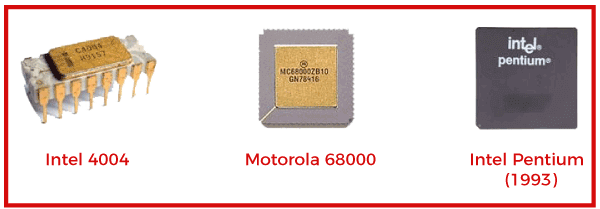 1971 - Intel 4004
- Designed by Intel's Federico Faggin and Ted Hoff and Busicom's Masatoshi Shima, it went on sale on November 15, 1971. "
- 2300 transistors with pMOS technology were used in the device.
- There were a total of 46 instructions.
- The intended clock speed was 1 MHz, but it was only achieved at 740 kHz.
- As the world's first microprocessor, it powered the Busicom 141-PF calculator, which is still in use today.
1972 - Intel 8008
- Introduced in August 1972, it is also known as MCS-8.
- CTC's Victor Poor and Harry Pyle worked on it, as did Intel's Ted Hoff, Faggin, Stanley Mazor, and Hal Feeney.
- There were 3500 transistors in it.
- But it was slower than the 4004.
- This computer had a clock speed of 0.5 MHz and a total number of 48 instructions.
- Micral and SCELBI were the first personal computers to use it.
1974 - Intel 8080
- Intel 8080 was introduced in 1974.
- Faggin, Mazor, and Masatoshi Shima created it in April 1974.
- The clock speed was increased to 2 MHz, and it used 6000 transistors and nMOS technology. »
- Most notable was the separation of the address (16 bit) and data (8 bit) buses, which was a major advancement.
- It also had 256 input/output ports.
- The MITS Altair 8800 and IMSAI 8080 both used it.
- Similarly, the main processor in Space Invaders (an arcade video game) was the 8080 microprocessor.
1974 - Motorola 6800
- The Motorola processor had no I/O ports.
- I/Os were memory-mapped.
- In addition, the instruction set contained 72 instructions at a clock speed of just 2 MHz
- HCF (Halt and Catch Fire) opcode was used for the first time, preventing the processor from responding to any interrupts until it was reset.
- Motorola introduced HCF, a self-testing feature, for the first time.
1977 - Intel 8085
The processor was also used as a microcontroller, operating on a +5V supply, unlike the other processors formed so far.
- Von Neumann architecture was used for the first time.
- "It was constructed with nMOS technology and 6500 transistors."
- There were 256 instructions in the instruction set.
- In NASA and ESA space explorations, the radiation-hardened version was employed.
1978 - Intel 8086
- The clock speed was designed to be 10MHz.
- Bruce Ravenel was part of the architecture development team, which included Stephen P. Morse.
- Jim McKevitt, John Bayliss, and William Pohlman designed Logic, with William Pohlman serving as the project manager.
- Mycron 2000 was the first microcomputer to use it.
1979 - Intel 8088
- HMOS-based 8088 was launched on July 1st.
- PLCC (plastic leaded chip carrier) package was available as well as a 40-pin DIP package. »
- There was only 8-bits of data in the path, however.
- 10 MHz was the intended frequency.
- 8088 was the basis for the original IBM PC.
1987 - SPARC
- It's a Sun Microsystems processor.
- It had a 40 MHz clock speed.
- 8 million transistors and 256 I/O pins were used to build it.
- According to the TOP500 list, Fujitsu's K Computer is ranked number one among the world's 500 fastest supercomputers.
- It was based on the SPARC architecture.
1991 - Am386
- There was a striking similarity between this AMD (Advanced Micro Devices) processor and Intel x86 processors.
- In terms of clock speed, the processor was a competitor to Intel's.
- Many manufacturers chose AMD's floating-point unit because of its excellent performance.
1993 - Pentium Processor
- P5 was the first Pentium processor.
- Two models were available: 510-pin version and 567-pin
- 1 million transistors were used in its construction.
- At the time, this 32-bit processor was the most advanced processor available.
- There were two instructions that could be executed at the same time in this superscalar x86 microarchitecture, speeding up computation.
1995 - Pentium Pro
- Pentium II was the first Pentium processor.
- It was packaged in a ceramic multi-chip module (MCM) with 387 pins, which was a first for the industry.
- In addition to its dual processor configuration, it has a 200 MHz clock speed.
- In order to build this processor, approximately 5.5 million transistors were used.
- MMX instructions were not included.
- This processor was utilised in ASCI Red, which had teraFLOP (one trillion floating-point operations per second) performance or results.
1997- Pentium II
- The Pentium II processor family was introduced on May 7 and offered a wide range of processors.
- With each new model, the clock speed was steadily increased to 450 MHz.
- A slot or socket module was used instead of the traditional processor.
- Because of this, computer manufacturers were able to fit it into a small space.
- Under this umbrella, a number of processors were introduced: Some of these were Klamath;
- Deschutes; Pentium II overdrive; Tonga, etc.
- It had a heatsink/fan combination that could be removed, which helped with heat dissipation.
1999-Pentium III
- It was introduced on February 26th.
- The SSE instruction was added to the previous model to speed up floating-point calculations.
- Like Pentium II, this processor was released in two versions: Celeron (low-end version) and Xeon (high-end version) (High-end version).
- The following processors are included in this family: Katmai; Coppermine; Coppermine T and Tualatin.
- PSN (Processor Serial Number) was introduced in the production process that formed the processor's unique identity.
1999 - Athlon
- Athlon was announced by AMD on June 23.
- A clock speed of 800 MHz was achieved by using 37 million transistors.
- It came in a 453-pin PGA (Pin Grid Array) package.
- It was faster than Intel's Pentium III, which made Athlon a legitimate competitor. »
- That made it the first processor to reach the 1 gigahertz speed mark in history.
- Enhanced 3DNow! was first launched, which sped up by 2-4 times.
2000-Pentium IV